In real-world projects, flame retardant fabric is rarely a “nice-to-have”. It becomes the difference between a smooth install and a last-minute scramble when a venue, client, or safety officer asks one simple question: Can you prove that what you’ve hung, wrapped, or installed is compliant?
If you work in event production, exhibition/stand building, hospitality fit-outs, or commercial interiors, you already know the pressure points: short lead times, shifting dimensions, tight build windows, and stakeholders who only care about fire performance when the doors are about to open.
This guide is written for project managers, stand builders, event producers, specifiers, and procurement teams who want a clear, practical way to choose the right fabric, get the documentation right the first time, and avoid common failure modes in installation, maintenance, and reuse.
What is flame retardant fabric: and what is it NOT?
Flame retardant fabric (also written as flame-retardant fabric, fire retardant fabric, or simply FR fabric) is textile material engineered or treated to reduce ignitability and/or slow flame spread under defined test conditions.
In practical terms, FR fabric is designed to:
- be harder to ignite
- self-extinguish more readily once the ignition source is removed
- reduce or delay flame propagation so people have more time to react
Flame retardant vs fire resistant vs fireproof
These terms are often mixed up in briefs and purchase orders:
- Flame retardant: describes textiles that limit ignition and flame spread under specific tests. The fabric can still burn under certain conditions.
- Fire resistant: a broader term that may describe materials that withstand heat/flame better, often used in PPE and industrial contexts. In interiors/events it’s commonly used informally.
- Fireproof: implies something will not burn. For most fabrics used in draping, curtains, and interiors, “fireproof” is not a realistic or appropriate claim.
If there’s one rule to keep your project safe (and your documentation defensible), it’s this:
Never assume the word “fireproof” applies to decorative or furnishing textiles. Always rely on the actual test standard + the report for the exact material and application.
Two paths to FR: inherently flame retardant (IFR) vs treated FR
In procurement you’ll see two broad categories of FR fabric:
- Inherently flame retardant (IFR) fabric
- Treated flame retardant fabric
Both can be valid. The best option depends on your project constraints and how the textile will be used over time.
1) Inherently flame retardant (IFR) fabric
IFR means the flame-retardant property is built into the fiber chemistry or the fiber blend itself. The FR performance is not merely a surface coating. (For a practical example in an event context, see our guide on flame retardant fabric for trade shows (B1/M1).)
Where IFR tends to shine (B2B reality):
- high frequency use (daily opening/closing of curtains)
- repeated handling and transport (touring productions, multi-event reuse)
- environments where cleaning is frequent (hospitality/public use)
- projects where “keeping compliance stable” matters more than minimizing upfront cost
Typical advantages:
- FR performance is generally more stable across the fabric’s service life
- less risk of “washing out” the protection (depending on fiber and care)
- often preferred for reusable systems
Typical trade-offs:
- can be more expensive
- fiber options and aesthetics can be more constrained depending on the supplier
2) Treated flame retardant fabric
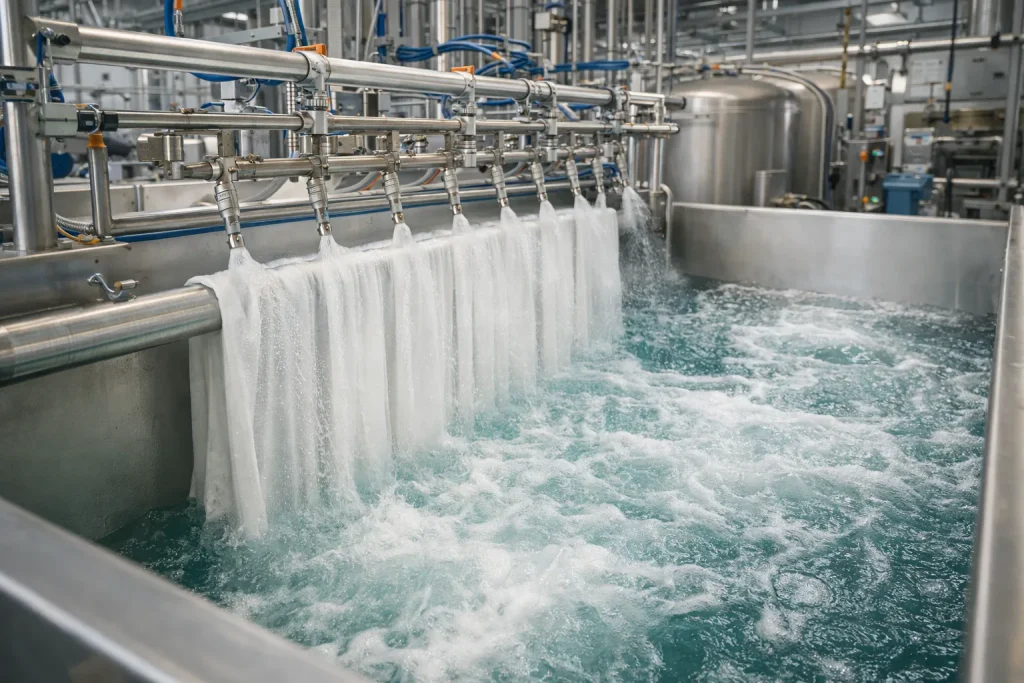
A treated FR fabric starts with a base textile and then receives a chemical treatment (or finish) that improves its fire behavior.
Where treated FR makes sense:
- short-lived installations (one-off events)
- very specific aesthetics that are difficult to achieve with IFR options
- projects where laundering is rare and the fabric is not exposed to harsh cleaning cycles
Typical advantages:
- can deliver great performance at lower upfront cost
- can allow a wider range of base textiles and looks
Typical trade-offs:
- performance can degrade due to washing, cleaning agents, abrasion, or time
- reuse requires stricter handling + a clearer re-testing/recertification strategy
Lifecycle cost: the hidden decision factor
Many teams evaluate FR fabric by purchase price. Experienced teams evaluate it by lifecycle cost:
- How many installs will this survive while still looking premium?
- What is the risk cost of a venue rejection?
- How often will it be cleaned—and by whom?
Next we’ll connect these categories to real use-cases: events, trade shows, hotels, offices, museums, and theatres.
Where FR fabric is used in B2B projects
The most common “FR fabric moments” are predictable: anywhere textiles become large surface areas in public spaces.
Events & event draping
In event production, FR fabric shows up as:
- pipe-and-drape systems
- backdrops for stages and photo moments
- ceiling drapes and tent liners
- room dividers for zoning and crowd control
In this world, logistics and speed matter as much as appearance:
- fabrics must pack efficiently
- wrinkles must be manageable
- labeling and modularity reduce install time
Trade shows & exhibition stands
For stand builders, FR fabric is the shortcut to large, premium surfaces:
- fabric wall covering panels
- exhibition drape for storage/backstage concealment
- soft partitioning for meeting spaces
The big advantage is the “high impact per kilogram”: textiles can create scale without heavy transport.
Hospitality (hotels) & contract textiles
Hotels often require FR performance in:
- drapes and curtains (blackout, dimout, sheers)
- decorative textiles in lobbies and conference areas
- partitions for flexible room layouts
Here, durability and maintenance become critical. Curtains are not static décor—they’re a high-touch component.
Offices & commercial interiors
In offices, FR fabric is increasingly used for:
- acoustic separation
- wall covering panels
- drapes to control glare and privacy
The goal is typically a combination of performance: fire behavior, acoustics, and visual softness.
Museums & theatres
Museums and theatres often rely on textile solutions for:
- controlled lighting (blackout)
- flexible scenography
- sound control
They also tend to be strict about documentation, especially for touring or public venues.
Next we’ll move from use-case to selection: how to choose the right FR fabric without getting stuck in endless sample rounds.
How to choose the right flame retardant fabric: a practical framework
A useful selection framework is to think in layers:
- Application mechanics (curtain vs wall vs ceiling)
- Performance requirements (light, acoustics, durability)
- Aesthetics (texture, color, drape)
- Project constraints (lead time, reuse, logistics)
1) Application type: curtain vs wall vs ceiling
Curtains/drapes need:
- good drape and pleat behavior
- smooth travel on track systems
- stable dimensions
Wall covering needs (see also our practical overview of fabric wall covering for events):
- crisp tension or clean flatness (especially with lighting)
- neat edge finishing
- compatibility with frames/profiles
Ceiling drapes need:
- predictable weight distribution
- safe rigging interfaces
- controlled sag (or engineered tension)
If your application is unclear, define it before you choose the textile. Many “wrong fabric” problems are actually “unclear application” problems.
2) Opacity: sheer/voile vs dimout vs blackout
Opacity is not just a style choice; it changes the project outcome.
- Sheer / voile: softens daylight, creates privacy without blocking light
- Dimout: reduces light significantly, but doesn’t eliminate it
- Blackout fabric: blocks light for AV, hotel rooms, and controlled environments
A common mistake is to specify blackout for a space that only needs dimming. Blackout can add weight and alter drape behavior—impacting tracks, pleat factor, and install.
3) Print needs: branding and color control
For trade shows and branded events, print is often non-negotiable.
Practical considerations:
- choose a fabric that supports the print method you need (often dye-sublimation)
- confirm color expectations under venue lighting (warm/cool, spot angles)
- plan seams and panel breaks so visuals remain clean
4) Acoustic needs: when fabrics help (and when they don’t)
Acoustic fabric is a frequent request, but expectations can be unrealistic.
Fabrics can support acoustics by:
- reducing reflections when used with enough surface area and pleat depth
- working as a facing layer for acoustic absorption material behind
Fabrics alone rarely “solve acoustics” in loud venues. Use them as part of a system: surface coverage + absorption + layout.
5) Handling & logistics: the “real” selection criteria
If your fabric is reused, the logistics plan is part of the spec.
Ask:
- Will we roll or fold this fabric?
- How do we label sets for fast install?
- Can wrinkles be steamed out quickly on site?
- What happens if one panel gets damaged—can we replace one module?
Next we’ll tackle compliance: standards, documentation, and how to avoid venue failure without turning the article into a legal lecture.
How to choose the right flame retardant fabric: a practical framework
Fire standards are not there to frustrate your team—they exist to reduce risk in spaces with large crowds, limited visibility, and complex evacuation routes.
The problem in real projects is not “standards exist”. It’s that:
- venues accept different standards
- project stakeholders use shorthand (“B1”, “M1”, “Class 1”) without context
- the same fabric behaves differently depending on how it’s installed (free-hanging vs backed vs lined)
The practical rule
Ask the venue/authority what they accept, then match fabric + application + documentation.
Common references you will encounter
Depending on your geography and client base, you may hear:
- EN 13773 (curtains and drapes)
- EN 13501-1 (Euroclass system for reaction to fire)
- DIN 4102 B1 (Germany)
- NF P 92-503 M1 (France)
- BS 5867 (UK curtains/drapes)
- NFPA 701 (USA event textiles and draping)
Do not try to “convert” one standard to another informally. If a venue requests a specific standard, provide that standard.
Next we’ll turn compliance into action: what documentation to prepare, how to match scope, and how to build a project folder that survives venue checks.
Documentation checklist: what venues actually ask for
In most venues, the conversation is short:
- What is the fabric?
- What is its FR classification / test standard?
- Can you show the proof?
What to include in a project folder
Create one digital folder per project (and ideally per reusable fabric set) with:
- fabric name and composition
- supplier product specification (weight, width, finish)
- certificate or test report (PDF)
- scope statement: what exactly is covered (fabric only vs fabric + print + backing)
- installation description (curtain, drape, wall, ceiling)
- photos or layout diagrams (optional but helpful)
Scope matching: the number one failure mode
The certificate must match:
- the exact fabric type/version
- the composition
- the relevant installation method (when specified)
- any relevant additions: lining, backing, coating, printing
If your fabric is printed, ask whether the print process and inks affect classification.
Installation & finishing that affects results
A common misconception is that FR fabric selection ends at purchase. In reality, finishing and installation are what determine whether the solution performs and looks professional.
Why seams, edges, linings and backings matter
They affect:
- how the fabric hangs (drape)
- how it travels on a track
- where stress points occur
- what is visible under lighting
- and sometimes, what classification applies
Common failure modes on install day
- Wrong pleat factor: curtains look thin and cheap, or overload tracks
- Poor hemming: wavey bottoms, uneven lengths, fraying
- Inconsistent panel widths: gaps at closure points
- Wrinkles from poor packaging: fabric looks “tired” on day one
- Missing documentation: delays at venue approval
Professional finishing recommendations
Depending on application:
- reinforcements at headers and hanging points
- weighted hems for better drape
- modular panel strategy for replacement
- consistent labeling of each panel’s position
Next we’ll cover care and maintenance—because FR performance and visual quality both depend on how fabric is treated after delivery.
Care & maintenance: keeping performance and appearance
Care is different for IFR and treated fabrics.
For IFR fabrics
- still follow supplier care guidance
- avoid aggressive chemicals that may damage fibers
- track cleaning cycles for heavily used hospitality textiles
For treated FR fabrics
- laundering and detergents may reduce performance
- cleaning protocols should be documented
- consider whether re-treatment or periodic re-testing is required
Handling & storage (the event reality)
- roll rather than fold when possible
- store dry and sealed to avoid moisture and odors
- protect edges and finishing points
- label sets clearly for fast installation
How to spec FR fabric without rework
If you want to specify flame retardant fabric without last-minute surprises, prepare three inputs before ordering:
- application (curtain, drape, wall, ceiling)
- dimensions (including pleat factor or tension system details)
- venue/country requirements (accepted standard + documents)
With those three, an experienced supplier can guide you to the correct FR fabric, the right finishing method, and a documentation set that will pass checks.
FAQ: flame retardant fabric
What is flame retardant fabric, in simple terms?
Flame retardant fabric is textile designed or treated to reduce ignition and slow flame spread under defined test standards.
Is flame retardant fabric the same as fireproof fabric?
No. “Fireproof” is not a reliable claim for decorative textiles. FR fabrics are tested to standards that describe specific behavior under specific conditions.
Should I choose inherently flame retardant (IFR) or treated FR for a hotel?
If the curtains are used daily and cleaned regularly, IFR often reduces lifecycle risk. Treated FR can work if care protocols and documentation are tightly controlled.
Can I print branding on flame retardant fabric for a trade show?
Often yes, but confirm that printing and any backing/lining are compatible with your compliance requirement and documentation.
What does B1 mean?
B1 is a common German classification (DIN 4102) used in many event and public-space contexts. Always confirm with the venue which standard they accept.
What does M1 mean?
M1 is a French classification (NF P 92-5xx series). If your project is in France or for French clients, this is commonly requested.
What is EN 13773?
EN 13773 is a European reference commonly used for curtains and drapes. It is increasingly specified in project environments.
What documents will a venue ask for?
Typically a certificate or test report showing the standard/classification for the exact fabric, plus the ability to match that fabric to the installed application.
Does washing affect FR performance?
It can. IFR fabrics tend to be more stable, while treated FR fabrics can lose performance depending on treatment chemistry and laundering.
How do I avoid failing a venue check?
Match the venue’s accepted standard, keep documentation for the exact fabric and application, label your installed sets, and keep proof accessible on site.